Starting a racquet club business is easy to imagine, but expensive to get wrong. A tennis, padel, or pickleball business plan is designed to mitigate that risk — but only if the assumptions underlying it are thoroughly researched and validated first.
Without this clarity, it’s easy to create a racquet club business plan that looks complete on paper but doesn’t translate well once real players, schedules, and staffing demands are involved.
This guide walks through the analysis that should happen before writing a tennis, padel, or pickleball business plan — covering how to evaluate demand, utilization, revenue behavior, and operating costs so the model holds up once the club is operating.
Important note: If you’re ready to document these decisions, see our guide on how to write a racquet club business plan, including a structured example and downloadable template.
Jump ahead to any section:
Define your core player segments and demand drivers
Validate local demand and access constraints
Identify competitive friction and unmet needs
Design your club’s intended player experience
Plan for court utilization
Consider how you will drive profit — and how it will actually behave
Determine your finances and understand operating costs
Build flexibility into your early assumptions
Validating your racquet club model before writing a business plan
Here, you’ll define how your club is meant to function before committing to a plan that’s difficult to unwind later. This is where decisions are made about who the club is for, how it will operate daily, and what conditions need to be true for the business to succeed.
This is the decision-making phase. The business plan comes later, once the model has been stress-tested and is ready to be documented.
Define your core player segments and demand drivers
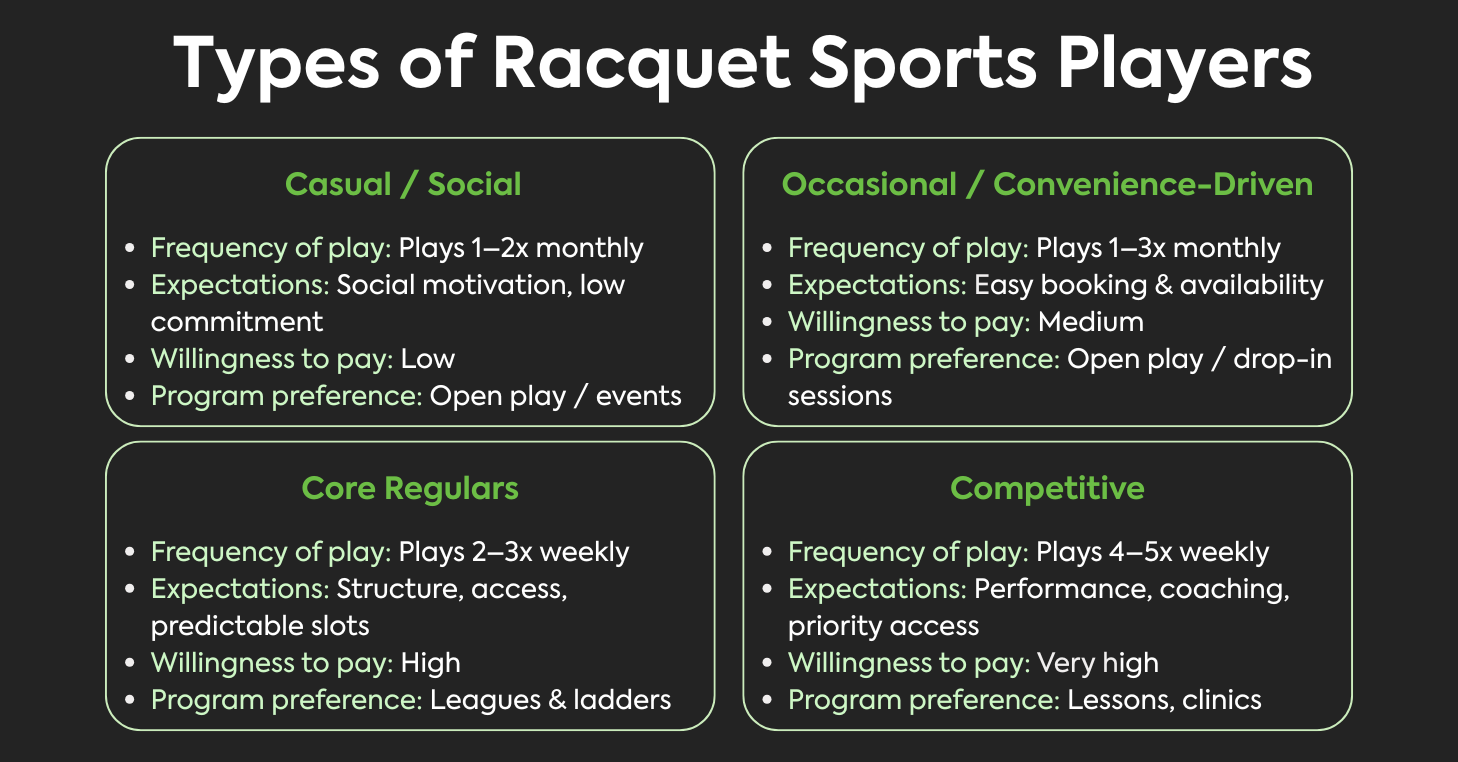
Sustainable demand depends on understanding which players return week after week — and what drives their participation.
Some players participate multiple times a week and expect flexible access and structured scheduling. Others play more occasionally and are drawn by atmosphere, community, and social connection.
These differences affect utilization, peak-hour pressure, and which programs actually support repeat play. Validating demand early helps prevent pricing, staffing, and schedules built around players who don’t show up consistently.
Anchor your assumptions in real player behavior by:
- Observing existing facilities in your area: When are courts busiest? Who plays during off-peak hours? Which formats drive repeat participation?
- Talking to players directly: Ask where they play now, what frustrates them, and what would make them play more often.
- Looking for behavior patterns, not opinions: Frequency of play, willingness to commit to memberships, and program preference data matter more than broad interest in the sport.
As you gather insights, focus on:
- Frequency of play: Who is most likely to show up consistently and drive repeat court usage?
- Willingness to pay: Are players paying for convenience and structure, or prioritizing lower prices and flexibility?
- Programming needs: Will demand center on competitive play, instruction, open play, or social formats?
These insights help ensure your tennis, padel, or pickleball business plan reflects a focused, intentional model. Without this clarity, clubs often try to serve everyone — and struggle to sustain consistent court usage, especially outside peak hours.
Validate local demand and access constraints
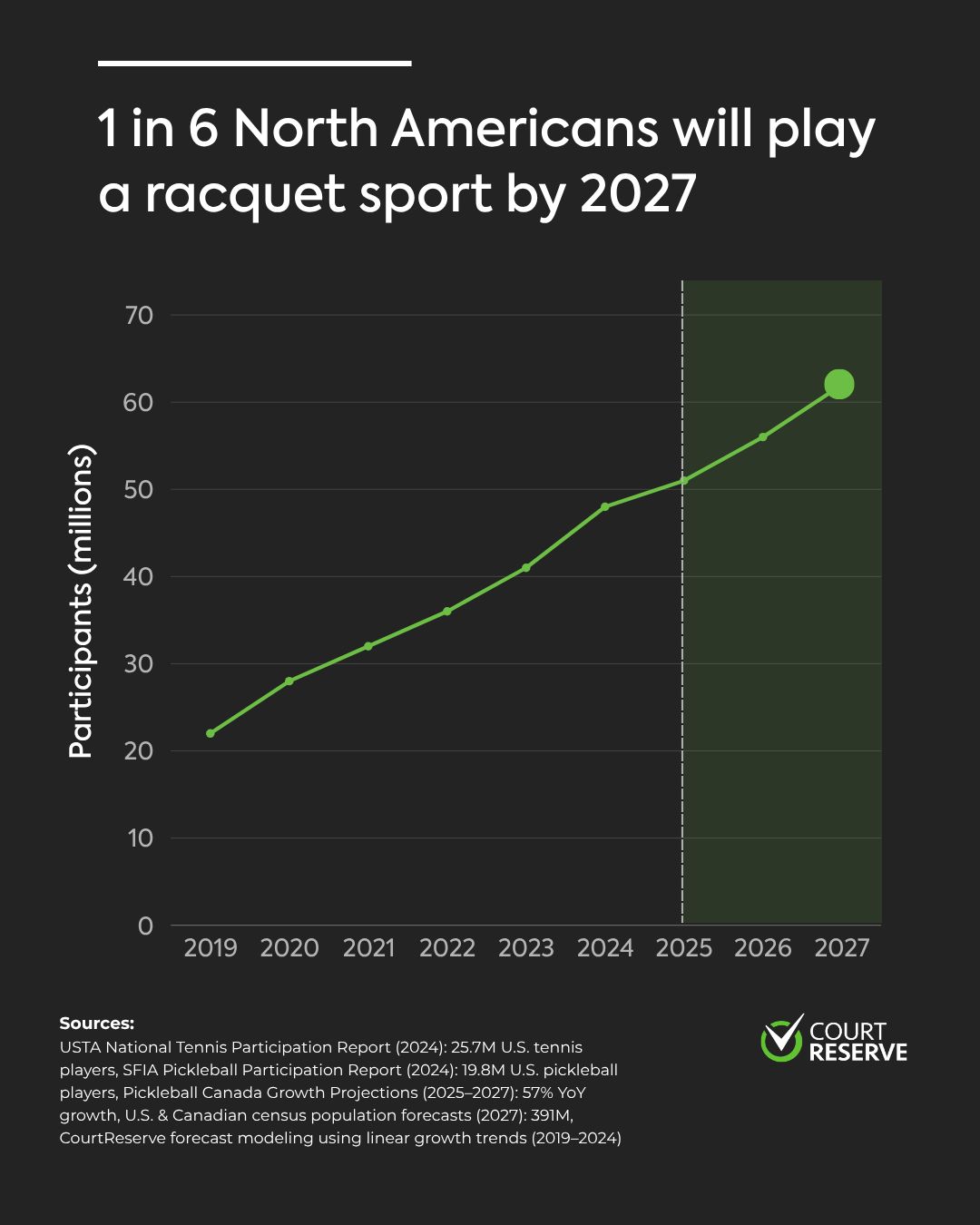
While national racquet sports growth statistics give you a general direction and validate interest, they don’t determine whether your model will work in your specific market. What matters is local demand — how players currently access courts and where that access breaks down.
Start by assessing the existing supply:
- Court availability: How many public and private options exist? Are courts indoor, outdoor, or seasonal?
- Overcrowding and access friction: Are courts consistently full? Do waitlists, time limits, or unclear scheduling rules restrict play?
These friction points often signal unmet demand.
Next, look for areas where the market is underserved:
- Time-based gaps: Early mornings, mid-day, late evenings, or weekends
- Format gaps: Leagues, open play, instruction, or social formats
- Skill-level gaps: Beginners, intermediates, or competitive players with limited options
As demand takes shape, pay attention to how play is currently discovered and organized. Instructors, league organizers, and highly active players often act as demand drivers. If those groups are already constrained by access or scheduling, early participation may come from existing communities rather than heavy promotion.
Local conditions should inform assumptions around operating hours, programming, pricing, staffing, and marketing — helping size the facility appropriately and reduce misalignment once the club is open.
Identify competitive friction and unmet needs
A strong competitive analysis focuses less on who’s nearby and more on how well existing options serve players. Understanding where current facilities create friction helps define a differentiated experience that directly informs pricing, programming, and operational choices from the outset.
Evaluate competitors across a few experience-driven dimensions:
- Access rules and availability: How easy is it to book a court? Are reservations fair and predictable, or confusing and restrictive?
- Organization and scheduling: Do leagues, open play, and clinics run smoothly, or do players feel frustrated by unclear schedules and last-minute changes?
- Programming and communication: Are programs consistent, well-structured, and clearly communicated, or do players have to hunt for information?
Pay attention to what players tolerate versus what makes them leave. Long waits, limited time slots, or disorganized programming may be acceptable when options are limited — but they often become reasons to switch once alternatives exist.
Direct player feedback is one of the fastest ways to validate these patterns. Ask where they play now, what they enjoy, and what they would change if they could. Conversations, reviews, and social media comments often surface recurring frustrations and unmet expectations that don’t show up in surface-level comparisons.
Design your club’s intended player experience
With demand, competition, and target players defined, the next step is outlining how those players will actually experience your club. A helpful way to approach this is by mapping the intended player journey — even before a facility exists.
Think through how someone moves from interest to regular participation:
- How do players first discover the club and understand what’s available? (marketing channels, website, program listings, onboarding communication)
- How do they book their first session or join a program? (website, mobile app, front desk support, instructor-led signups)
- How do they transition from casual play into repeat visits, leagues, or instruction? (follow-up communication, beginner pathways, recommended programs, visible next-step options)
From there, define the rules players interact with. Access, scheduling, and participation should feel predictable and easy to understand. Clear expectations make it easier for players to commit and return.
Be specific about:
- Who gets priority access, and when? (members vs non-members, programs vs drop-in, instructors vs general booking)
- What happens when demand spikes? (waitlists, booking limits, time caps, blackout windows for events)
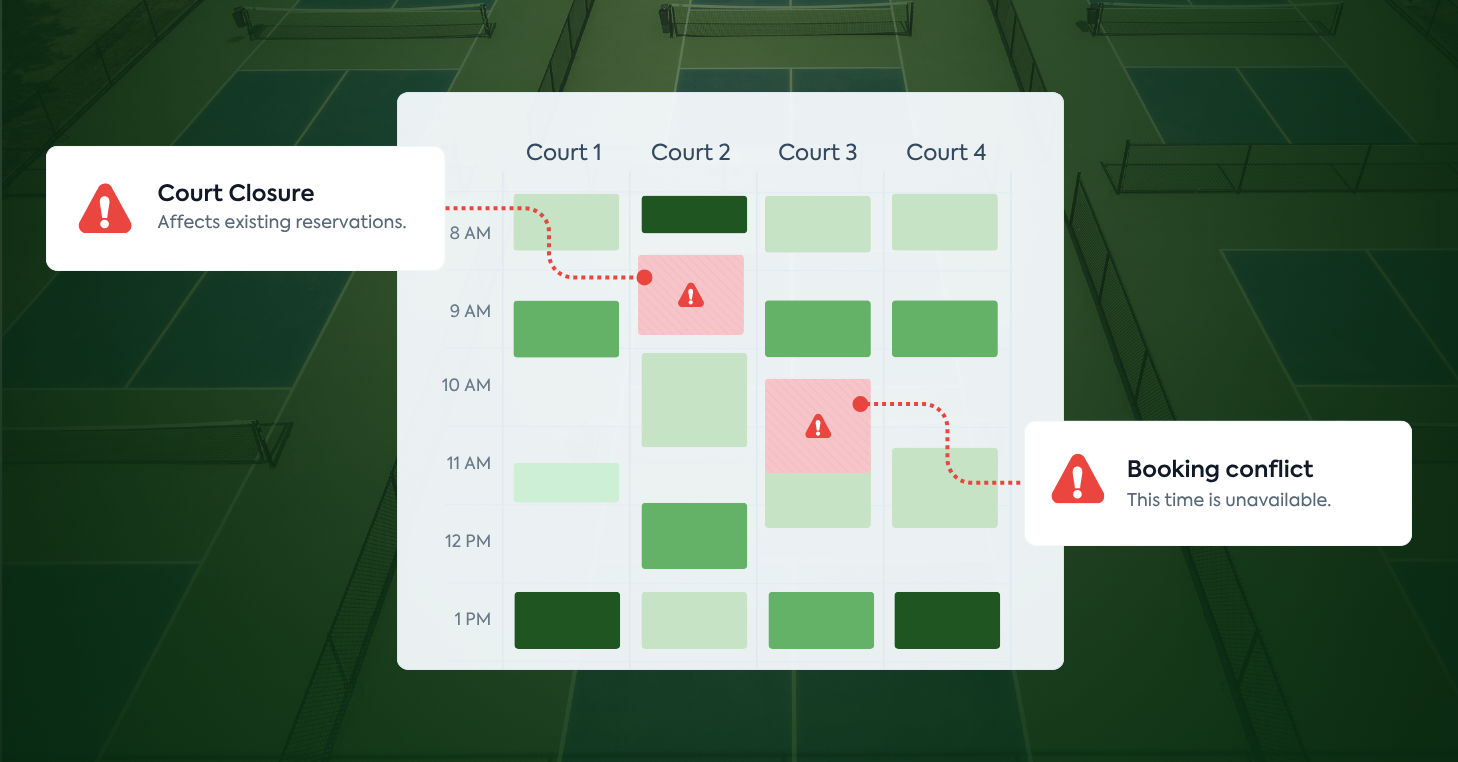
- How will scheduling be managed day to day? What is self-serve vs. staff-managed? (general bookings, programs, special events)
- How are changes handled? (cancellations, reschedules, and no-shows should follow clear, consistent rules players can understand upfront)
Finally, plan programming and events with player progression in mind. Open play, leagues, lessons, and tournaments work best when they feel connected, helping players move naturally from one level of engagement to the next.
This kind of upfront clarity makes the experience easier to understand, manage, and scale.
Plan for court utilization
Courts are fixed, perishable resources. Once an hour goes unused, it’s gone. That makes when and how courts are used just as important as how many you build.
Utilization assumptions affect nearly every downstream decision in your tennis, padel, or pickleball business plan — from revenue projections to pricing decisions and staffing coverage. So instead of assuming steady demand from day one, evaluate how utilization will realistically vary throughout the week and year:
- Peak vs. off-peak demand: Which hours naturally fill, and which require intentional effort to drive usage?
- Program pressure: Which programs compete for peak court time, and which support utilization elsewhere?
- Weekday vs. weekend usage: How different does demand look between a Tuesday afternoon and a Saturday morning?
- Seasonal fluctuations: How do weather patterns, school schedules, or local events affect participation over time?
You can validate these patterns by reviewing your court utilization data if you already operate a facility. Or, you can observe usage at existing clubs, check public court availability, and talk directly with local players about when they play — and when they struggle to find court time.
Consider how you will drive profit — and how it will actually behave
Revenue planning needs to happen early — before projections, pricing, or staffing decisions lock in assumptions that don’t hold up.
Most racquet sports clubs generate revenue in two ways:
- Predictable revenue: memberships or prepaid packages
- Variable revenue: reservations, programs, lessons, events, equipment rentals, retail, food and beverage, etc.
Predictable revenue adds stability and forecasting confidence. Variable revenue is less consistent, but drives higher Revenue Per Player (RPP). The key is recognizing that these revenue types behave differently — and planning for them accordingly.
From there, get specific about which revenue streams you intend to support. Research how players already behave at local facilities. How often do they play? What do they pay for?
As you evaluate each stream, pressure-test it with a few practical questions:
- Does this revenue stream require court time, staff time, or both?
- Does it fit naturally into a player’s routine, or does it rely on extra effort to sell?
- Does it scale with utilization, or depend more on traffic and dwell time?
- Does it meaningfully increase RPP, or simply add operational complexity?
Remember, you don’t need to cover every revenue stream. What matters is choosing a mix that aligns with your players, capacity, and staffing realities.
Determine your finances and understand operating costs
Similar to revenue, operational costs also fall into two groups:
- Fixed costs: Expenses that exist whether one person plays or one hundred, such as rent, insurance, permits, utilities, court reservation software, basic maintenance, and so on.
- Activity-driven costs: Expenses that increase as participation grows, such as staffing coverage, coaching pay, cleaning, payment processing fees, etc.
To estimate these costs accurately, map out how a typical operating day works on paper:
- When is the facility open?
- Which hours or tasks require staff or oversight?
- What happens when bookings change, payments fail, or players cancel?
Once that workflow is clear, identify the recurring tasks required to run the club day-to-day and assign time and cost to each. Keep in mind that even with automation, changes like cancellations, refunds, and reschedules still require setup, monitoring, and ownership. Account for who handles them and when — not just which tools are used.
Finally, pressure-test your assumptions by asking:
- Which costs exist even on slow days?
- Where could unclear policies create extra work or lost revenue?
- Which parts of the operation become more complex or fragile as demand increases?
Use this information to create an initial budget that reflects both how revenue is generated and where operating costs come from as the club runs day to day.
Build flexibility into your early assumptions
Many clubs operate smoothly at launch, then struggle as participation increases — not because demand disappears, but because early decisions were too rigid. Access rules that felt fair at 100 players break down at 500. Programming that worked for a small group doesn’t scale to a larger audience.
As you pressure-test your assumptions, look for areas where flexibility matters most:
- Access and policies: If participation doubles, do your booking rules, membership caps, or priority access still work?
- Programming structure: Can you add leagues, clinics, or social formats without crowding out core play?
- Player pathways: Is there a clear progression from first-time player to regular, league participant, or lesson-taker?
- Differentiation levers: Can you introduce new formats, technology, or experiences over time without reworking your entire model?
Strong plans don’t assume you’ll stay small or rush to scale. They recognize that player needs evolve, competition increases, and early decisions should hold up beyond day one. The goal is a model that can adapt as momentum builds — so growth stays manageable, not stressful.
Turning analysis into decisions
The work outlined here creates the foundation for a business model that can withstand real operating pressure. Validating demand, utilization, revenue behavior, and operating costs early makes tradeoffs visible and reduces surprises once your club is live.
This analysis strengthens your business plan. When assumptions are tested first, the plan becomes a record of informed decisions rather than a collection of guesses.
From here, those decisions should be documented clearly and consistently in a tennis, padel, or pickleball business plan that partners, lenders, and internal teams can actually evaluate and revisit over time.