New pickleball & racquet sports clubs don’t fail on vision. They stall when the business behind the courts isn’t clearly articulated.
A solid business plan makes the mechanics of the club visible. How courts are monetized, how memberships and programs fit together, how costs scale, and how growth is funded. That clarity is what allows partners, lenders, and internal teams to align around execution instead of assumptions.
This guide walks through the essential sections of how to write a racquet club business plan, explains what each section should communicate, and shows how they connect. It also includes a completed example and a downloadable template you can use to structure your own plan.
Important note: strong business plans reflect assumptions that hold up under real operating conditions. Researching and validating demand, utilization, and economics should happen before those decisions are documented. Learn how in our business plan prep guide.
Jump to any section of the business plan:
Executive summary
Company overview & operating model
Market opportunity & competitive context
Operations plan: organization, systems, management & services
Marketing, demand, & growth strategy
Financial plan
Financial projections
Racquet club business plan example
Creating your tennis or pickleball business plan
A well-written business plan is structured so others can quickly understand how your racquet sports club is intended to operate. The emphasis here is on organizing the plan so core decisions are presented clearly and consistently.
Before drafting, it’s worth deciding which type of business plan you need. Lean plans work well for internal alignment or early idea validation. Traditional business plans are typically required when funding, partners, leases, or permits are involved.
For this guide, we’ll walk through a traditional structure. It’s the most common format for racquet clubs and gives you space to explain your operating model, assumptions, and financials — without leaving critical questions unanswered.
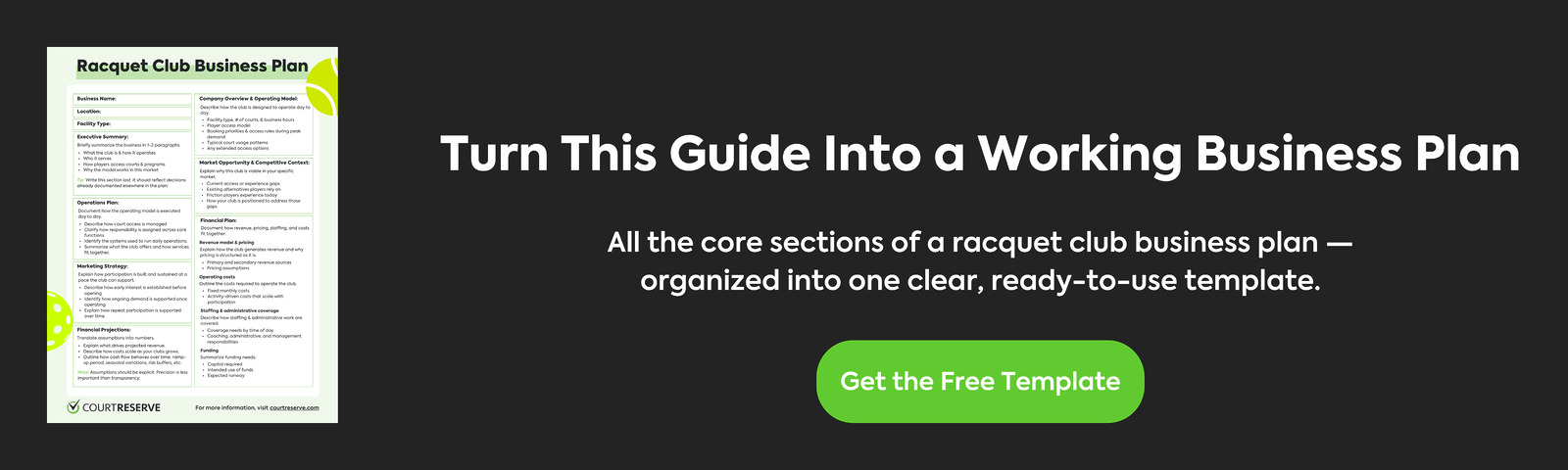 (PDF)(opens in new window)
Executive summary
The executive summary is the opening section of your tennis or pickleball business plan. It’s a concise, high-level overview of your entire model that helps a reader quickly understand:
- What the club is: The type of facility and overall operating model
- Who it serves: The primary player segments
- How it operates: High-level look at access, programming, revenue, etc.
- Why it works: The core factors that make the model sustainable
Although it appears first, it’s a good idea to write the executive summary last, once the rest of the plan is complete. Creating it earlier often leads to vague positioning or unsupported projections.
When drafting this section, focus on documenting decisions already made elsewhere in the plan rather than introducing new ideas. Avoid buzzwords and inflated claims. And remember, clarity and credibility matter more than persuasion. A strong executive summary should make the rest of the plan easier to understand and trust.
If you’re seeking financing, this is also where you briefly reference scale, timeline, and high-level financial expectations.
Company overview & operating model
Here, you’ll explain how your club will operate and function day to day. This is where decisions around demand, access, and capacity are translated into a clear picture of how the business will actually run.
After this overview, a reader should understand:
What type of facility this is
Specify whether the club is dedicated to pickleball, tennis, padel, multi-sport, indoor, outdoor, or seasonal play. Include any physical constraints that shape operations, such as court count, layout, or hours of availability. This should be informed by insights around local demand, competition, and capacity.
How players interact
Explain how players access courts in practice: memberships, packages, drop-in bookings, programs, or a combination. Access rules and booking priorities should clearly reflect how the club is designed to operate, especially during periods of high demand.
How court time is actually used
Describe how court time is typically allocated across programs, lessons, events, and private rentals over the course of a week. This does not need to be granular, but it should reflect realistic operating behavior rather than idealized availability.
Market opportunity & competitive context
This section establishes why existing options in the local market fail to fully meet player demand. That might look like overcrowded public courts, limited indoor access, long wait times, or programming that works for some player segments but not others.
From there, zoom out and acknowledge the alternatives players rely on — public courts, private clubs, multi-sport facilities, and informal groups. Note how each option solves part of the player’s need while introducing friction around availability, consistency, cost, scheduling, or overall experience.
Then, connect the dots by showing how those conditions shape opportunity. Describe how the club is positioned in response to local gaps and constraints, and how the operating model addresses friction players experience in the market. When the connection between market conditions and the club’s design is apparent, the opportunity speaks for itself.
Operations plan: organization, systems, management & services
The operations plan details how your club’s operating model is executed day to day. It documents ownership, systems, and processes that support daily activity as the club runs and grows.
Key areas to address include:
Court access, scheduling, and player flow
Explain how courts, programs, and schedules fit together over the course of a day and week. Access rules, priority windows, and court allocation should show how players book time, join programs, and move through the club experience without unnecessary friction.
Management & ownership
Define who is responsible for core operations like programming, scheduling, payments, and member communication. In smaller clubs, roles may overlap — what matters is that accountability and ownership is clear across tasks.
Core systems & technology
Describe the systems that support day-to-day racquet clubs operations. Booking, payments, access, communication, and reporting should be treated as core infrastructure.
Services & offerings
Summarize what the club offers — court access, programs, instruction, memberships, and add-ons — and how those offerings support repeat play and ongoing engagement.
A strong operating model here shows both players and partners that the club is built to function reliably at scale.
Marketing, demand & growth strategy
Your club’s demand and growth strategy explains how participation is built and sustained in a way the club can actually support. It should demonstrate that growth is intentional, paced, and reinforced by the experience your club delivers — rather than dependent on constant promotion or novelty.
So, you’ll need to explain how players discover the club, get involved for the first time, and continue participating over time.
Pre-launch demand
Early demand matters more than many operators expect. Describe how you plan to create early visibility and seed participation before opening day — without overwhelming the facility. Common approaches include:
- Waitlists or founding memberships to capture early interest
- Community partnerships with schools, parks, or local organizations
- Instructor-led visibility, where coaches bring existing followings into early programs
Ongoing growth channels
Once the club is live, growth should be driven primarily by repeat behavior. Identify the channels relied on to support steady demand, such as:
- Referral loops and word of mouth that are easy for players to use
- Local SEO and Google visibility for players actively searching for courts or programs
- Email and in-app communication that keeps players informed and engaged
- Events and programs designed as acquisition tools, not just short-term revenue spikes
Retention and consistency
Sustainable demand is driven by player retention. Explain how repeat participation is supported once players are acquired. Focus on the structural elements that keep players engaged over time, such as:
- Ongoing communication and re-engagement efforts that reduce drop-off
- Consistent scheduling and reliable access that support habit formation
- Familiar programs and formats that reduce friction and uncertainty
- Clear progression paths that give players a reason to continue participating
Financial plan
As the name suggests, your financial plan documents the economic structure of your racquet club. It connects revenue, pricing, staffing, and costs to the operating model so the business can be evaluated beyond surface-level projections.
Here, you’ll cover:
Revenue model & pricing logic
Detail how your club will generate revenue across memberships, court access, programs, instruction, events, and add-ons. Then explain why pricing is realistic. Reference projected utilization patterns, peak vs. off-peak demand, and staffing limits to show that rates are grounded in reality.
Operating costs
Lay out your recurring costs clearly. Staffing, software, maintenance, utilities, insurance, marketing, and any other expenses that repeat monthly should be easy to spot. Don’t overlook activity-driven costs that increase with participation, such as additional staffing coverage, administrative load, and system oversight during peak periods.
Staffing & administrative coverage
Describe staffing in terms of coverage, not job titles. Which hours require on-site support? When are coaches on court? Where can self-serve access reduce labor?
Funding
If you plan to raise capital, this is also where to summarize funding needs at a high level. Include how much capital is required, what it will be used for (including startup costs like buildout, equipment, early operating runway), and how long it’s expected to support the business before cash flow stabilizes.
These assumptions then form the basis for the financial projections that follow.
Financial projections
Financial projections show how the business is expected to perform based on your racquet club business plan.
When putting projections together, cover these three core areas:
Revenue forecasts
Base revenue projections on what the facility can realistically support, given court availability, operating hours, and staffing capacity. If revenue is projected to increase over time, be specific about what’s driving that change — higher utilization, expanded programming, or pricing adjustments.
Operating expenses
Expense projections should mirror the staffing coverage and operating patterns already defined. As utilization and participation increase, labor and other costs should scale accordingly rather than staying artificially flat.
Cash flow
Projections should show how the business maintains sufficient cash reserves and remains solvent as participation and utilization fluctuate throughout the year. This includes early ramp-up periods, seasonal variation, and slower months.
Clear assumptions matter more than precise numbers. The value of a projection is in showing how inputs connect — not in claiming exact outcomes.
Racquet club business plan example + template
Below is a simplified example of how a traditional tennis or pickleball club business plan might look when written using the structure outlined above.
This example is intentionally concise. Its purpose is to show how decisions are documented clearly and consistently — not to suggest specific numbers or strategies. And keep in mind that your own plan will likely include more detail based on your facility, market, and goals.
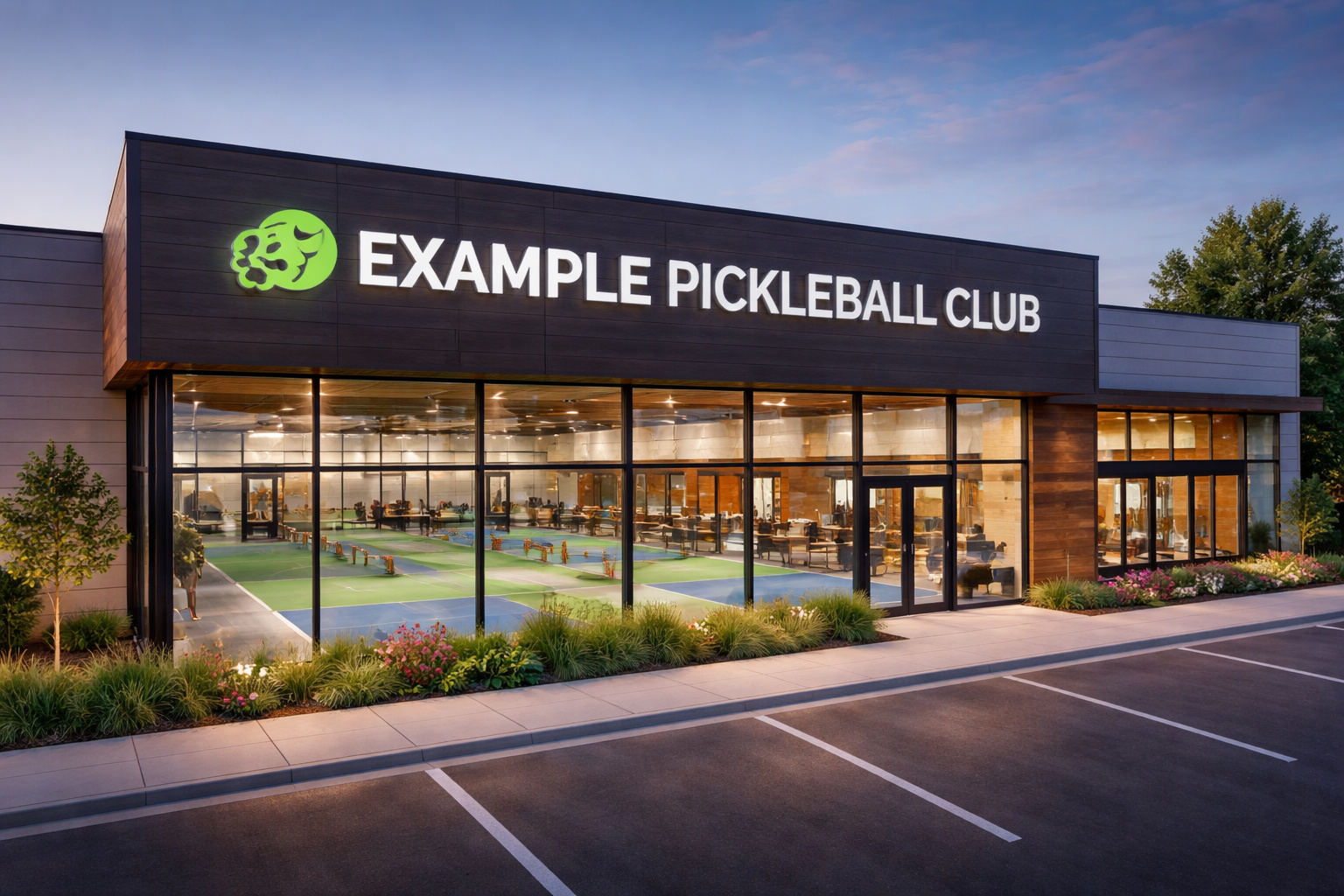
EXECUTIVE SUMMARY
Club name: Example Pickleball Club
Location: Suburban market with strong year-round demand
Facility type: Indoor pickleball club with food & beverage service
Example Pickleball Club is an indoor pickleball facility designed to provide consistent, year-round access in a market where public courts are overcrowded and indoor options are limited. The club operates 10 indoor courts and includes a casual food and beverage offering that encourages social play and longer visits.
The club serves adult recreational players, beginners entering through clinics, and competitive players participating in leagues. Players access courts through memberships, prepaid packages, and program-based bookings. The model works by aligning access rules, programming, staffing, and hospitality services with expected demand, supporting steady utilization without excessive operational complexity.
COMPANY OVERVIEW & OPERATING MODEL
The club operates as a single-location, indoor facility open seven days per week, with staffed peak hours and designated after-hours access for approved members.
Players access courts through memberships, prepaid packages, and scheduled programs. Members receive priority booking during peak evening and weekend hours, while off-peak periods support flexible bookings, lessons, and clinics.
Court time is intentionally allocated to balance demand across the week. Evenings focus on leagues and structured play, daytime hours support instruction and open access, weekends combine programs and events, and after-hours blocks increase utilization during low-cost operating windows.
MARKET OPPORTUNITY & COMPETITIVE CONTEXT
Local pickleball demand is high, but existing options are fragmented. Public courts are frequently overcrowded, indoor access is limited, and private clubs often require long-term commitments that reduce flexibility.
The club is positioned to address these gaps by offering reliable indoor access, transparent scheduling, extended hours, and a combined sport-and-social experience that reduces friction around availability and consistency.
OPERATIONS PLAN
All court bookings, programs, and events are managed through a centralized club management system with defined booking rules, priority windows, and waitlists. After-hours access is limited to approved members and designated court blocks.
The owner oversees daily operations. A programming lead manages leagues, clinics, and events. An operations lead oversees scheduling, payments, member communication, and coordination between court activity, after-hours access, and food and beverage service.
CourtReserve is used as the club’s primary management platform, supporting booking, payments, communication, access workflows, and reporting. Remote access control is integrated to support secure, self-serve entry during approved after-hours periods.
Services include court access, leagues, clinics, instruction, memberships, events, and on-site food and beverage service.
(PDF)(opens in new window)DEMAND, GROWTH & MARKETING STRATEGIES
Pre-launch demand is seeded through founding memberships and partnerships with local instructors who bring existing players into early programs.
Once operating, growth is supported through member referrals, local search visibility, and consistent communication around schedules, programs, and events. Leagues and social events are designed to convert first-time players into repeat participants.
Retention is supported through predictable scheduling, familiar program formats, clear progression paths, and social touchpoints that encourage ongoing engagement.
FINANCIAL PLAN
Revenue is generated through:
- Memberships
- Court bookings
- Leagues
- Lessons & clinics
- Events
- Food & beverage sales
Pricing reflects differences between peak and off-peak demand, court capacity, and staffing requirements, with after-hours access increasing utilization without proportional labor costs.
Recurring costs include:
- Rent: $000
- Utilities: $000
- Insurance: $000
- Software: $000
- Staffing: $000
- Marketing: $000
- Food & bev operaitons: $000
Variable costs scale with participation and include:
- Instructor pay: $000
- Facility maintenance / cleaning: $000
- Payment processing fees: $000
Initial funding supports:
- Buildout: $000
- Equipment: $000
- Food & bev setup: $000
- Early operating runway until cash flow stabilizes: $000
FINANCIAL PROJECTIONS
Projections are based on ten courts operating across both staffed hours and after-hours access, with utilization ramping over the first 12 months. Revenue growth is driven by increased utilization, expanded programming, and food and beverage sales rather than aggressive pricing changes.
Operating expenses scale with participation, particularly labor and food and beverage costs during peak periods. Cash flow projections account for ramp-up timing, seasonal variation, and slower months, showing how sufficient reserves are maintained to support ongoing operations throughout the year.
| Item | Monthly (USD) | Yearly (USD) |
| Revenue | $000 | $000 |
| Operating Cost | $000 | $000 |
| Net Profit | $000 | $000 |
*Note: In a completed business plan, this section would include detailed financial statements, specific numbers, data visuals, and supporting assumptions tailored to the club’s market and capacity.
Planning for the long run
A well-built tennis or pickleball business plan continues to earn its keep after your club opens.
As demand patterns, schedules, and participation evolve, the plan helps operators assess whether access rules, pricing, programming, or staffing still make sense — and where adjustments are warranted. Having those decisions documented makes change easier to manage and less reactive.
Use the downloadable template to capture your model clearly, then revisit it as conditions change. Treated as a working document, the plan supports smarter decisions over time and helps the club stay aligned as it grows.