The racquet and paddle sports facility industry has grown up. After years of explosive pickleball growth, new facility announcements, and breathless media coverage, the question has shifted from “is this real?” to “what actually works?”
We went looking for answers.
Today we’re releasing the State of the Racquet & Paddle Sports Facility Industry, 2026–27 — the first report built on real operational data from thousands of facilities across North America, combined with a 222-respondent operator survey. We co-produced it with IAPPF, the global trade association for pickleball and padel facilities.
It also draws on anonymized platform data — actual revenue, booking patterns, member retention, technology adoption — from dedicated pickleball clubs, tennis/pickleball blends, country clubs, and multi-sport facilities. The result is one of the most granular pictures of facility economics the industry has seen.
Download the full report →(opens in new window)
Three findings that stood out
The scheduling gap is the #1 revenue opportunity.
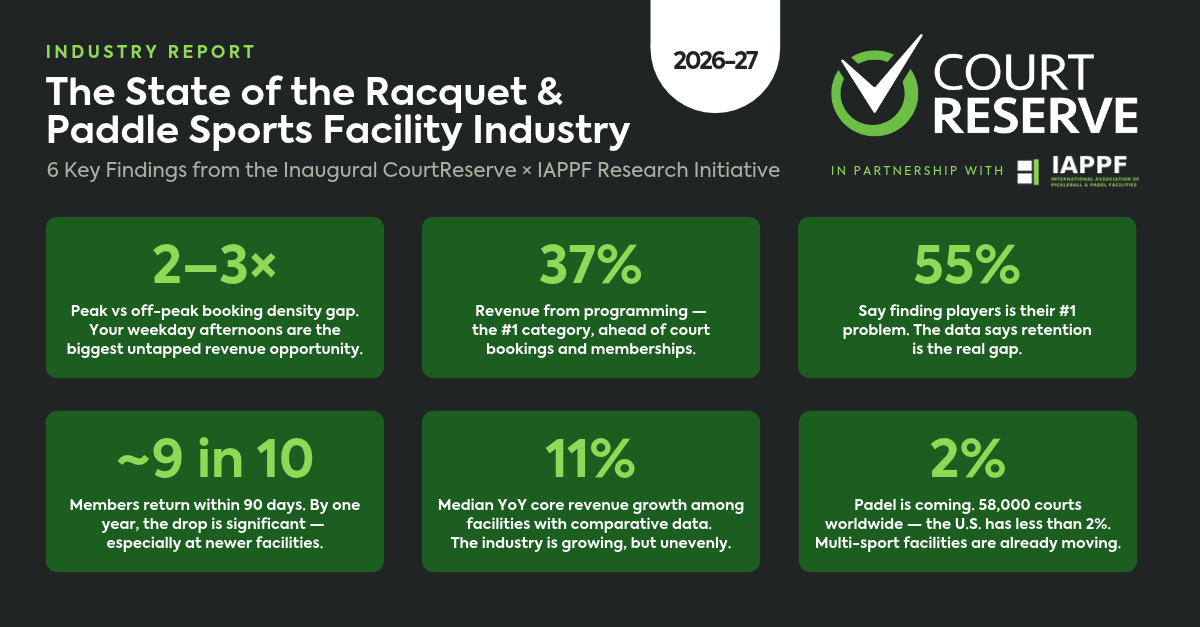
Weekend mornings and weekday evenings run at 2–3× the booking density of weekday afternoons. Nearly every facility has significant underutilized capacity during the midday valley. The operators who fill those hours — through programming, pricing, or targeted segments — will transform their economics without adding a single court.
Programming generates more revenue than court bookings.
This surprised us. Across dedicated pickleball facilities, programming and events account for 37% of core revenue, ahead of court reservations (33%) and memberships (30%). And facilities with balanced revenue across all three categories are disproportionately represented among growers.
The industry has a retention problem it doesn’t know about.
55% of operators say their biggest challenge is attracting new players. Getting them in the door is working, with roughly 9 in 10 members returning in the first 90 days. However, retention drops sharply by the one-year mark. The industry is spending its energy filling the top of the funnel (listen, we all need new players) while the bottom quietly drains.
What else is in CourtReserve’s State of the Industry report?
The State of the Racquet & Paddle Sports Facility Industry 2026–27 covers revenue, court utilization, member retention, and technology adoption at thousands of North American racquet and paddle facilities.
Here’s what’s in the report:
- How the facility landscape is shifting from hypergrowth to maturation
- Revenue composition, and what separates growing clubs from declining ones
- Utilization patterns and the scheduling gap
- How member retention holds up through the first year
- Technology adoption and the strongest performance signal in the dataset
- What operators are thinking, and where confidence outpaces investment
- The padel opportunity for North American clubs
- Lessons from mature international markets
- What to watch in 2027
Every section closes with “What to do about it” — specific, prioritized actions operators can take immediately.
Why we built this
We sit on one of the largest datasets in racquet sports: thousands of facilities, millions of bookings, years of operational data. We believe that data should serve the industry, not just our business. A healthier, better-informed industry is better for everyone in it, including us.
David Johnson and the IAPPF team brought the global perspective, the operator relationships, and the international context that makes this more than a platform report.
Get the report
The full report is free. No gate, no paywall. Download it here.
If you’re an IAPPF member, you’ll also find it in your member resources. If you’re not yet a member, this is a good reason to get to know them.
We’ll be publishing deeper dives into individual findings over the coming weeks. Follow along on LinkedIn and Instagram.